What you'll learn
- Why your artistic skill level has zero influence on the biological effects measured
- The precise neurological reason why the brain stops ruminating during coloring
- What a meta-analysis of 578 participants proves about mandalas vs. free drawing
- Measurable changes in as little as 15 minutes, according to Kaimal herself (TIME Magazine, 2026)
- Which technique to choose based on your available time: from 10 minutes to 1 hour
Contents
7- Stress in 2025: Numbers That Should Alarm Everyone
- How Adult Coloring Reduces Stress: What the Studies Say
- How to Lower Cortisol Naturally with Coloring
- Art Therapy, Mandala, Zentangle: What’s the Difference and What Are the Benefits?
- 5 Scientifically Proven Anti-Stress Coloring Techniques
- How to Start Anti-Stress Coloring Tonight (Without Buying Anything)
- Conclusion
Every evening, millions of people come home exhausted, their minds racing with thoughts that won’t stop. You’ve probably tried meditation, relaxation apps, herbal teas, maybe even medication. And nothing really sticks.
So when someone tells you that anti-stress adult coloring can reduce cortisol in 75% of practitioners, the natural reaction is skepticism. That’s fair. You’ve been sold miracle solutions before.
Except this time, it isn’t a wellness influencer speaking. It’s a study published in the Art Therapy Journal of the American Art Therapy Association (2016, DOI: 10.1080/07421656.2016.1166832), conducted by researcher Girija Kaimal of Drexel University, with real biological measurements: salivary cortisol measured before and after each session.
In this article, you’ll discover exactly what the science says, without exaggeration or minimization, and five concrete techniques you can apply tonight, with no artistic talent or expensive materials required.
Stress in 2025: Numbers That Should Alarm Everyone
Three in four adults feel the physical and emotional toll of stress
According to the American Psychological Association’s Stress in America survey (2023), 76% of adults report experiencing significant physical or emotional symptoms caused by stress. More troubling: 57% say stress paralyzes them, leaving them unable to make important decisions.
Younger adults are particularly affected: Generation Z and Millennials consistently report the highest stress levels of any age group tracked by the APA. And the numbers don’t capture the full picture, as many cases go unacknowledged or undiagnosed.
The American Institute of Stress estimates that stress costs US employers over $300 billion annually in lost productivity, absenteeism, and healthcare. That’s the economic floor. The human cost is immeasurable.
Why classic remedies no longer work
Faced with this reality, conventional solutions have often shown their limits.
Medication — anti-anxiety drugs, sleeping pills — provides short-term relief but carries dependency risks. Benzodiazepine prescriptions have risen steadily, reflecting a widespread struggle to find sustainable alternatives to daily stress management.
Meditation is effective (the scientific evidence is solid), but it remains inaccessible for many. Sitting still when your mind is racing at full speed is a skill that must be developed. For people who “can’t get there,” frustration compounds the stress.
Is there a natural, scientifically proven alternative that requires no special training, no talent, and no patience? Recent research in neuroscience and art therapy points toward a surprising answer.
How Adult Coloring Reduces Stress: What the Studies Say
The study that changed everything: Drexel University, 2016
In 2016, researcher Girija Kaimal, associate professor at Drexel University’s College of Nursing and Health Professions (Philadelphia), published a study that would become a landmark in art therapy.
Her protocol was simple and rigorous: 39 adults aged 18 to 59 were invited to 45 minutes of free artistic creation: coloring, clay modeling, drawing. Their salivary cortisol levels were measured before and after the session.
The result was unambiguous: 75% of participants saw their cortisol drop after the creative session. And the most striking detail? Prior artistic experience had no influence whatsoever. People with no artistic training benefited as much — sometimes more — than trained artists. “It was surprising, and yet it wasn’t,” Kaimal told Drexel University in an official release.
This study, published in the Art Therapy Journal of the American Art Therapy Association (2016, DOI: 10.1080/07421656.2016.1166832), is today the central reference on anti-stress adult coloring.
Mandalas vs. free coloring: what does the science show?
If Kaimal confirmed that artistic creation reduces cortisol, an earlier study had asked an even more precise question: do all coloring styles produce the same results?
In 2005, researchers Nancy Curry and Tim Kasser (Art Therapy Journal, vol. 22, no. 2, pp. 81–85) compared three groups after inducing an anxious state:
- Coloring a structured mandala
- Coloring a geometric pattern
- Free drawing without guidance
Result: coloring mandalas reduced anxiety significantly more than free drawing. The structure and symmetry of the mandala appear to be the decisive therapeutic factor, independent of any spiritual dimension.
This result has since been confirmed by a meta-analysis of 8 studies involving 578 participants, published in the Art Therapy Journal (DOI: 10.1080/07421656.2021.2003144), which concludes that mandala coloring systematically reduces state anxiety compared to free drawing.
What exactly happens inside your brain
Several neurological mechanisms explain these measurable effects.
The amygdala and prefrontal cortex. A 2024 systematic review in Frontiers in Psychology (Barnett & Vasiu, PMC11480958) analyzed the neurological mechanisms of creative arts: it concludes that creative engagement, including visual creation, consistently activates the medial prefrontal cortex (mPFC) and amygdala, two structures central to emotional regulation. This activation is associated with improved ability to manage negative emotions, including chronic stress.
The flow state (Csikszentmihalyi). Psychologist Mihaly Csikszentmihalyi defined flow as a state of total absorption in an activity where time and worries fade away. Researchers have shown that mandala coloring, with its repetitive structure and calibrated difficulty, can foster this state of deep concentration (Frontiers in Psychology, 2024).
The visual and motor cortex simultaneously. Coloring activates the visual cortex (processing shapes, colors, outlines) and the motor cortex (fine motor control of hand movements) at the same time. This dual sensory and motor engagement keeps the brain in a state of gentle engagement: active enough to stop ruminating, not intense enough to generate stress.
All of these mechanisms are consistent with what Kaimal directly measured in 2016: a drop in cortisol, the stress hormone, in 75% of participants after 45 minutes. Cortisol is the biological marker of sympathetic nervous system activation (the body’s alarm system). Its reduction suggests a gradual return to a state of physiological calm. And all of this with a coloring page and a pencil.
What happens in your brain during coloring
Cortisol down in 75 % of participants after 45 min of coloring — Kaimal, 2016
How to Lower Cortisol Naturally with Coloring
Cortisol: the stress hormone explained simply
Cortisol is not the enemy. Short-term, it’s essential: it mobilizes energy, sharpens attention and prepares the body to respond to a threat. This is the “fight or flight” response our ancestors needed to survive.
The problem is chronic cortisol: the kind that settles in when the hormone stays elevated for weeks, months. Its effects on the body are documented: disrupted sleep (cortisol interferes with melatonin), weight gain (particularly abdominal), weakened immune system, and progressive mood degradation that can lead to anxiety or depression. This is the price of a body that stays permanently on alert, never receiving the signal that the danger has passed.
The central question becomes: how do you lower cortisol naturally, without medication, without complex techniques to master?
45 minutes: the reference study’s number
The Kaimal study (2016) used 45-minute sessions. That’s the duration at which a measurable and significant cortisol reduction was observed in 75% of participants. 45 minutes is the length of a TV episode, a commute, a lunch break.
But what’s even more encouraging is what Kaimal has said more recently. In an article published by TIME Magazine in April 2026, she states: “We’ve seen changes within 15 minutes.” There’s no need to block out a full hour. A few minutes are enough to begin the process of cortisol reduction.
What happens in your body during 45 min of coloring
- 0 min
Brain in active stress mode
- 5–10 min
Thoughts slowing down, focus on shapes
- 15 min ✦
First measurable effects on cortisol — Kaimal
- 20–30 min
Flow state, rumination decreases
- 45 min
Cortisol down in 75 % of participants
Even without artistic skill, it works — and it’s proven
Perhaps the most surprising result of the Kaimal study: participants with no artistic training benefited from the same cortisol reductions, sometimes even greater, than trained artists.
Why? Because the benefit doesn’t come from the aesthetic quality of the work. It comes from the process itself: the attention paid to shapes, colors, and gestures. It is this progressive absorption that triggers the measured effects. The quality of the drawing doesn’t matter. What matters is picking up the pencil and starting.
In other words: anti-stress adult coloring is one of the rare activities where the absence of talent is not only acceptable, but irrelevant.
Art Therapy, Mandala, Zentangle: What’s the Difference and What Are the Benefits?
Art therapy: when creation becomes supervised therapy
Art therapy is a professional practice distinct from self-directed coloring. The American Art Therapy Association defines it as a discipline that “enriches the lives of individuals, families and communities through active art-making, creative process, applied psychological theory and human experience within a psychotherapeutic relationship.”
In plain terms: art therapy involves a trained therapist, a clinical protocol, and addresses specific situations: trauma, severe depression, chronic illness. It is not what you do on a Sunday evening with your colored pencils.
But — and this is crucial — that doesn’t mean self-directed coloring is without effect. The studies cited in this article (Kaimal 2016, Curry & Kasser 2005, the 2021 meta-analysis) focus precisely on autonomous practices, without a therapist. The measured benefits, cortisol reduction and decreased anxiety, apply to simple coloring at home.
Note: Anti-stress coloring is a daily wellness practice, not a medical treatment. For depression, a severe anxiety disorder, or burnout, it can complement professional care, not replace it.
Anti-stress adult mandalas: what the science proves
Among all coloring types, anti-stress adult mandalas enjoy the strongest scientific support. The Curry & Kasser studies (2005) and the 2021 meta-analysis (578 participants) show that the geometric structure and symmetry of mandalas produce anxiety reduction significantly greater than free drawing or unstructured coloring.
The researchers’ hypothesis: the repetitive symmetry of the mandala gives the brain a precise, predictable visual anchor that facilitates a state of progressive concentration without requiring creative effort. The framework is given. You just fill it in.
Zentangle and zen drawing: an alternative validated by research
Zentangle, a method of drawing repetitive, structured patterns, follows a mechanism similar to mandalas. Two recent studies provide serious evidence:
- A study published in Brain and Behavior (PMC11338741, 2024) measured the brain activity of 30 adults during Zentangle sessions using EEG: the data shows increased brain activity in several frequency bands, particularly theta and alpha waves, characteristic of the calm, focused states associated with meditation.
- A second study (PubMed, PMID 35943847) concludes that regular Zentangle practice reduces anxiety and improves self-compassion in adults.
Zentangle’s advantage over mandalas: it requires no pre-printed template. A blank notebook and a pen are all you need, making it even more accessible for beginners.
Art Therapy, Mandala, Zentangle: what’s the difference?
- Therapist Required
- Materials Specialized
- Solo studies No
- Accessibility Low
- Cost Paid
- Therapist Not required
- Materials One pencil
- Solo studies Yes (×2)
- Accessibility Very high
- Cost Free (PDF)
- Therapist Not required
- Materials Pen + notebook
- Solo studies Yes — 2024
- Accessibility Very high
- Cost Free
5 Scientifically Proven Anti-Stress Coloring Techniques
Science establishes that coloring reduces stress: Kaimal (2016), Curry & Kasser (2005) and the 2021 meta-analysis prove it. What follows are five practical ways to apply this science to your daily life, based on your availability and needs.
1. Mandala coloring — 20 minutes
For: beginners who want fast results without complex materials.
Choose a mandala of medium complexity: not too simple (low engagement), not too dense (frustrating for a first try). One colored pencil and a fine felt-tip pen are enough. The goal isn’t to finish the mandala: it’s to lose yourself in it for 20 minutes. Let your hand decide the colors.
Why it works: the structure and symmetry of the mandala are the documented therapeutic factors (Curry & Kasser, 2005).
2. Mindful coloring — 30 to 45 minutes
For: those who want the benefits of meditation without “meditating” in the classic sense.
Turn off notifications. Get comfortable. Before starting, take three slow breaths. Then bring your full attention to the sensations: the pressure of the pencil on the paper, the colors building up, the sound of each stroke. The quality of the result doesn’t matter; what matters is the quality of the attention.
Why it works: focusing on present-moment sensations is the mechanism of mindfulness, whose anti-stress effects are independently established.
3. Flow coloring — 45 to 60 minutes
For: those seeking deep disconnection and with time to spare.
Choose a complex and detailed coloring page: fine-line mandalas, architectural landscapes, botanical patterns. The complexity is intentional: it forces the brain to engage deeply enough to reach the flow state described by Csikszentmihalyi. Soft music in the background, phone in another room.
4. Evening coloring ritual — 15 to 20 minutes
For: people who have trouble falling asleep or tend to ruminate at night.
Practice one hour before bed, with dimmed lighting. Favor soft colors: blues, greens, light mauves. The cortisol reduction measured by Kaimal (2016) is directly compatible with sleep preparation: lower cortisol is a physiological signal of the body transitioning to rest mode.
5. Work break coloring — 10 to 15 minutes
For: people stressed at work with little time available.
A small mandala notebook in your bag, a ballpoint pen. That’s all you need. As Kaimal declared in TIME Magazine (April 2026): “We’ve seen changes within 15 minutes.” Ten minutes during a lunch break is enough to trigger the relaxation response.
Summary table
| Technique | Duration | Level | Main benefit |
|---|---|---|---|
| Mandala | 20 min | Beginner | Quick anxiety reduction |
| Mindful coloring | 30–45 min | Intermediate | Deep mental calm |
| Flow | 45–60 min | All levels | Full disconnection |
| Evening ritual | 15–20 min | Beginner | Better sleep |
| Work break | 10–15 min | Beginner | Express de-stress |
How to Start Anti-Stress Coloring Tonight (Without Buying Anything)
The minimum materials to get started
The barrier to entry is almost nonexistent. Here’s what you actually need:
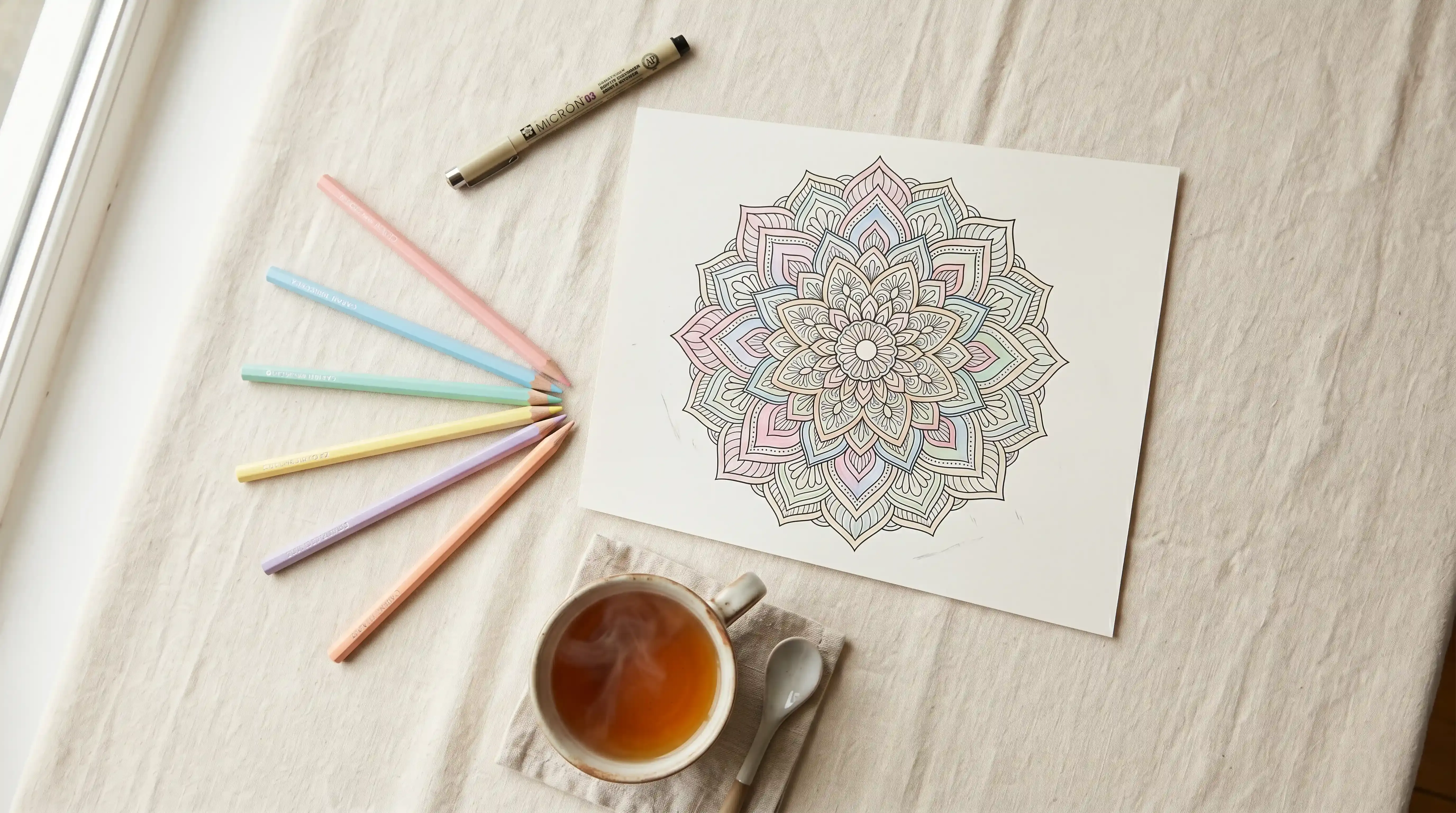
- A printed coloring page, available for free on Kolorii, directly downloadable as a PDF
- 4 to 6 basic colored pencils: a standard box is more than enough. No need for Copic markers or professional drawing materials. The quality of the result isn’t the goal.
- 15 minutes. And if you’re skeptical, start with 5.
That’s it. No subscription, no classes, no prior skill required.
The 3-minute rule
The real barrier isn’t materials: it’s getting started. A tired mind seeks minimum resistance, and pulling out a notebook requires an effort that fatigue amplifies.
The rule is simple: you only need to commit for 3 minutes. Open the PDF, print it or display it on your tablet, pick up any pencil and start filling in one area, any area at all. After those 3 minutes, cognitive engagement takes over. The state of absorption described in the studies sets in gradually.
To make starting easier: prepare your materials the night before and leave them somewhere visible. Immediate accessibility removes friction.
Where to start: choosing the right coloring page
Complexity level matters, especially for the first sessions:
- Beginner: medium geometric mandala (wide shapes, clear lines, few details)
- Intermediate: floral or nature-pattern mandala, with more variety in zones
- Advanced: very detailed mandala or zen landscape, for long flow sessions
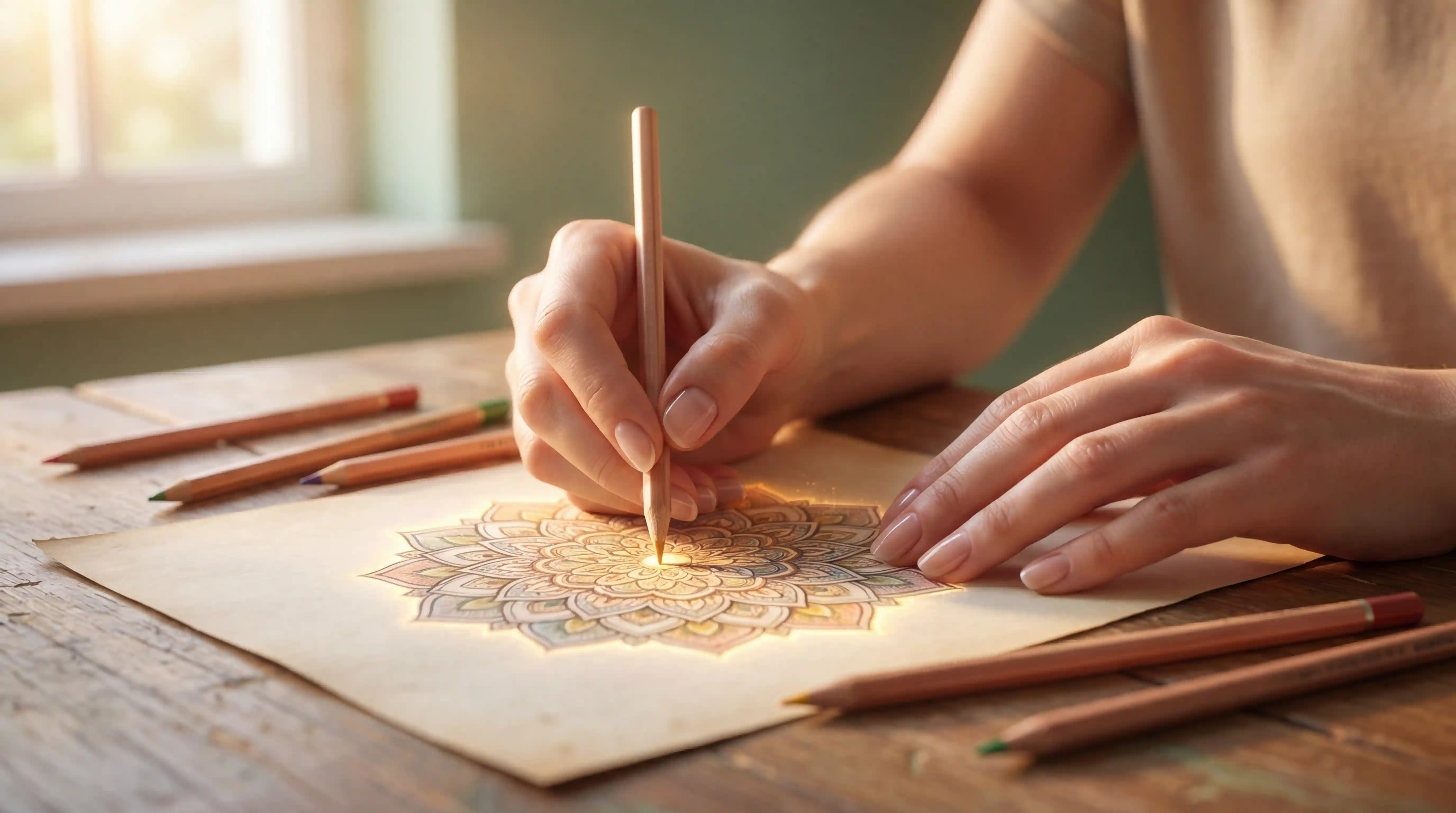
To show you what this looks like in practice, we took one of our mandalas from our free collection and colored it.
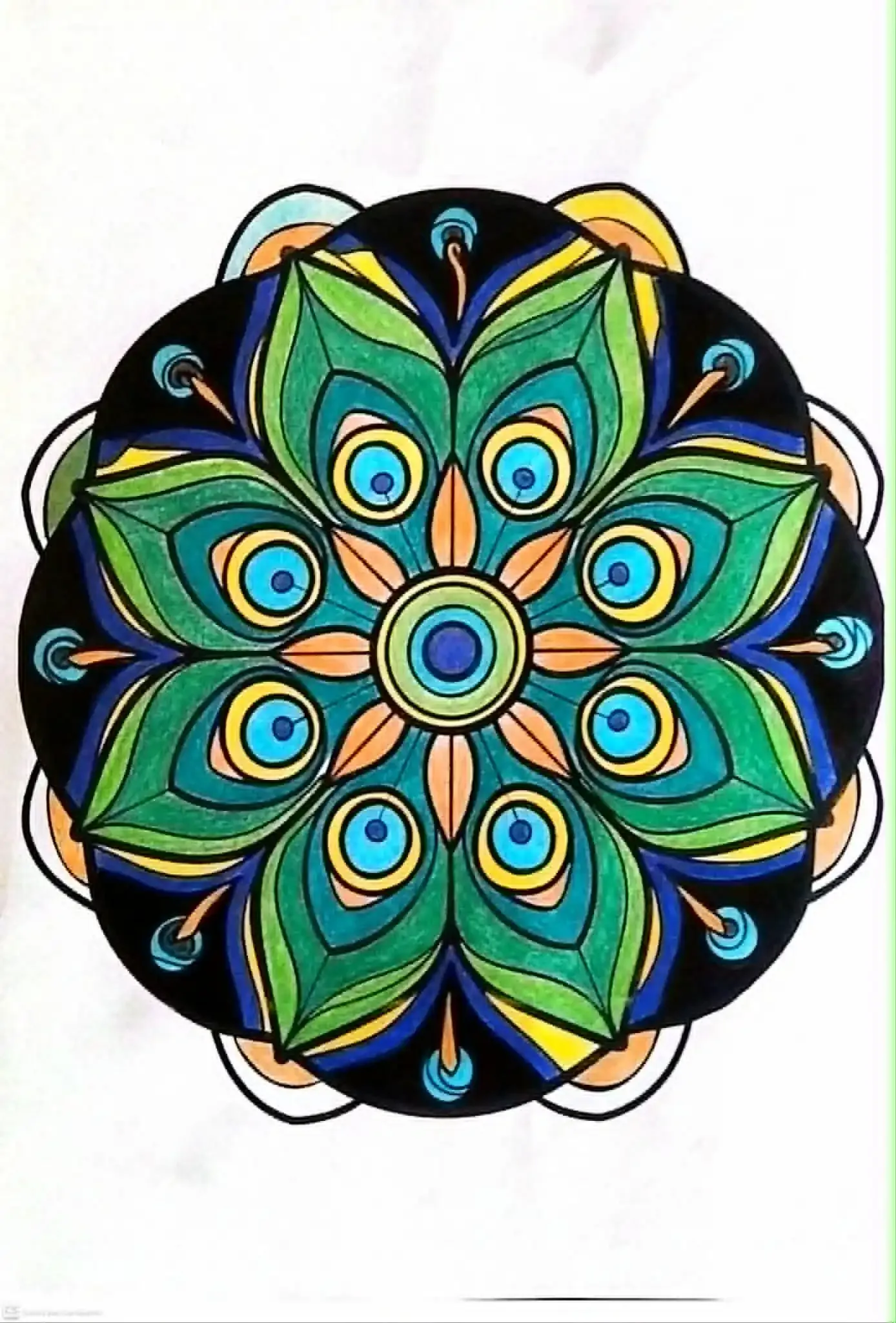
We did it in five separate sessions, 20 minutes each. Not all at once. A little every evening. And honestly, that’s when we understood what the research is talking about: we weren’t thinking about much else during those 20 minutes. The colors, the zones, the progress. That was it.
You’ll find dozens of mandalas like this one in our free collection, from beginner to highly detailed.
Dozens of anti-stress mandalas, free and downloadable as PDF.
View all our anti-stress mandalas →And if you color it, we’d love to see your version. Share it in our Facebook group. Every result is different, and that’s exactly what makes it fascinating.
→ Join the group and share your mandala
FAQ — Anti-Stress Adult Coloring
5Is adult coloring really anti-stress or just a placebo effect?
How long do you need to color to feel the effects?
Do you need to know how to draw to practice anti-stress coloring?
Is coloring as effective as meditation for stress?
Can coloring be used for anxiety or depression?
Conclusion
What science says is clear: anti-stress adult coloring is not a trend. It is an activity whose effects on cortisol, anxiety, and emotional regulation are documented by studies published in peer-reviewed scientific journals. A therapeutic coloring practice maintained regularly is a wellness habit accessible to anyone.
What science also says is that you don’t need to be an artist. You don’t need an hour. You don’t need expensive materials.
You need a coloring page, a pencil, and to begin.
Three points to remember:
- 45 minutes of coloring reduces cortisol in 75% of people, regardless of artistic skill level
- Mandalas are the most effective for reducing anxiety, thanks to their structure and symmetry
- In as little as 10–15 minutes, effects are already measurable. Start small, stay consistent.