
The printable sheet
One Letter page: the numbered chart with its codes, an empty row to recreate each shade, and a strip for your tests.
Free tool · color chart
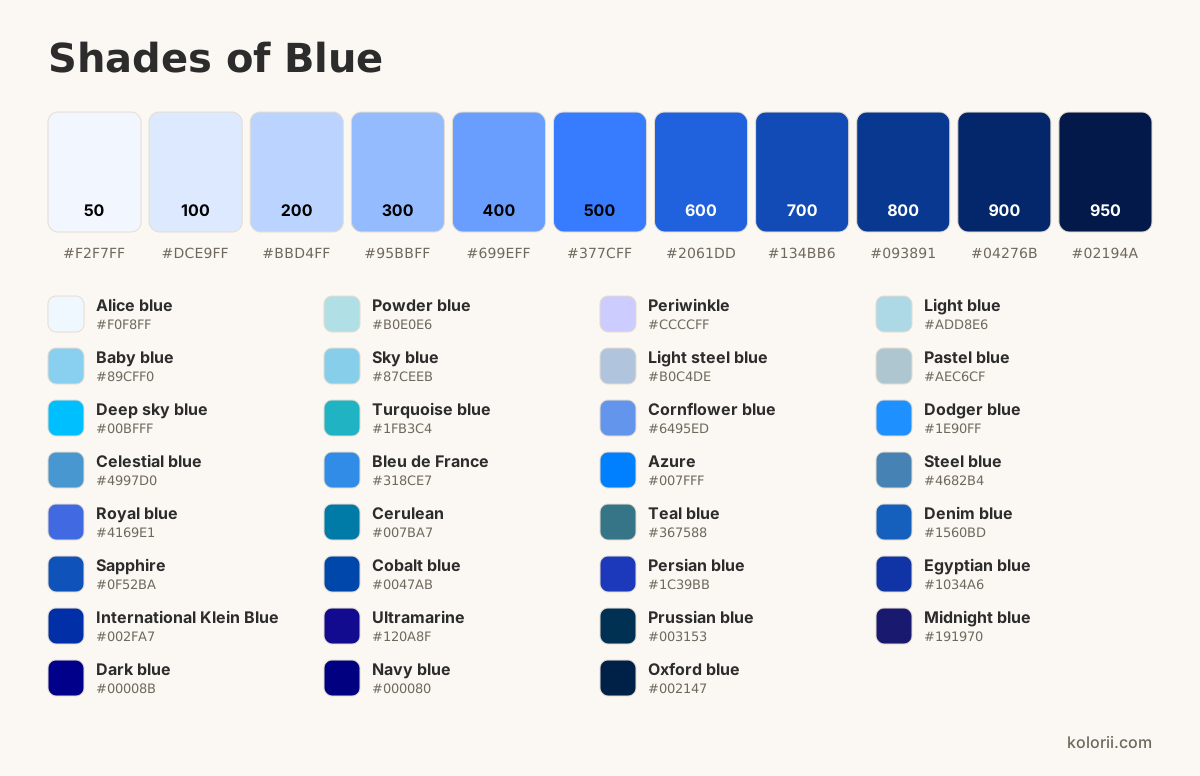
From almost-white Alice blue to midnight blue, here are the different shades of blue, each with its name and code. Click a swatch to copy its HEX, RGB or CMYK code, or make your own shade of blue with the sliders.
Blue 500
Closest named shade: Azure #007FFF
#377CFF rgb(55, 124, 255) 78, 51, 0, 0 hsl(219, 100%, 61%) Make your own shade
Pale, airy blues, from Alice blue to periwinkle: ideal for a background or the sky in a coloring page.
True blues, neither too light nor too dark: royal blue, azure, cornflower, cerulean…
Deep blues, from sapphire to navy and Oxford blue, the darkest shade of blue before black.
Every shade of blue on this page with its HEX, RGB and CMYK codes, copied in one click.
| Shade | HEX | RGB | CMYK | |
|---|---|---|---|---|
| Alice blue | #F0F8FF | rgb(240, 248, 255) | 6, 3, 0, 0 | |
| Powder blue | #B0E0E6 | rgb(176, 224, 230) | 23, 3, 0, 10 | |
| Periwinkle | #CCCCFF | rgb(204, 204, 255) | 20, 20, 0, 0 | |
| Light blue | #ADD8E6 | rgb(173, 216, 230) | 25, 6, 0, 10 | |
| Baby blue | #89CFF0 | rgb(137, 207, 240) | 43, 14, 0, 6 | |
| Sky blue | #87CEEB | rgb(135, 206, 235) | 43, 12, 0, 8 | |
| Light steel blue | #B0C4DE | rgb(176, 196, 222) | 21, 12, 0, 13 | |
| Pastel blue | #AEC6CF | rgb(174, 198, 207) | 16, 4, 0, 19 | |
| Deep sky blue | #00BFFF | rgb(0, 191, 255) | 100, 25, 0, 0 | |
| Turquoise blue | #1FB3C4 | rgb(31, 179, 196) | 84, 9, 0, 23 | |
| Cornflower blue | #6495ED | rgb(100, 149, 237) | 58, 37, 0, 7 | |
| Dodger blue | #1E90FF | rgb(30, 144, 255) | 88, 44, 0, 0 | |
| Celestial blue | #4997D0 | rgb(73, 151, 208) | 65, 27, 0, 18 | |
| Bleu de France | #318CE7 | rgb(49, 140, 231) | 79, 39, 0, 9 | |
| Azure | #007FFF | rgb(0, 127, 255) | 100, 50, 0, 0 | |
| Steel blue | #4682B4 | rgb(70, 130, 180) | 61, 28, 0, 29 | |
| Royal blue | #4169E1 | rgb(65, 105, 225) | 71, 53, 0, 12 | |
| Cerulean | #007BA7 | rgb(0, 123, 167) | 100, 26, 0, 35 | |
| Teal blue | #367588 | rgb(54, 117, 136) | 60, 14, 0, 47 | |
| Denim blue | #1560BD | rgb(21, 96, 189) | 89, 49, 0, 26 | |
| Sapphire | #0F52BA | rgb(15, 82, 186) | 92, 56, 0, 27 | |
| Cobalt blue | #0047AB | rgb(0, 71, 171) | 100, 58, 0, 33 | |
| Persian blue | #1C39BB | rgb(28, 57, 187) | 85, 70, 0, 27 | |
| Egyptian blue | #1034A6 | rgb(16, 52, 166) | 90, 69, 0, 35 | |
| International Klein Blue | #002FA7 | rgb(0, 47, 167) | 100, 72, 0, 35 | |
| Ultramarine | #120A8F | rgb(18, 10, 143) | 87, 93, 0, 44 | |
| Prussian blue | #003153 | rgb(0, 49, 83) | 100, 41, 0, 67 | |
| Midnight blue | #191970 | rgb(25, 25, 112) | 78, 78, 0, 56 | |
| Dark blue | #00008B | rgb(0, 0, 139) | 100, 100, 0, 45 | |
| Navy blue | #000080 | rgb(0, 0, 128) | 100, 100, 0, 50 | |
| Oxford blue | #002147 | rgb(0, 33, 71) | 100, 54, 0, 72 |
In paint, blue is a primary color: no mix makes it, so you start from a blue tube or pencil. In printing, cyan and magenta layered together make blue, and on screens blue is one of the three colors of light, with red and green. Every shade of blue, though, can be mixed from a basic blue.
cyan + magenta
Cyan and magenta inks layered together make a deep blue. With paint, the same mix leans purple instead.
blue + white
Add the blue to the white, a little at a time: one drop of blue tints a lot of white.
blue + a touch of black
A touch of black darkens blue. For a richer navy, swap the black for a little orange, its opposite color.
blue + green + a touch of black
Two parts blue to one part green, then a touch of black for depth.
blue + a touch of purple + plenty of white
A blue with a hint of purple, lightened with plenty of white: the color of the periwinkle flower.
Depending on your supplies
With pencils, you don’t mix: you layer. Lay down the lightest shade in light strokes, then the darker one on top, without pressing. To lighten blue, finish with a white pencil; to darken it, add a touch of grey or of its opposite color.
Water-based markers don’t blend well: pick the right shade straight away. With alcohol markers, go over a darker shade with a lighter one while it is still wet to soften the transition.
Mix on the palette, not on the paper. For a lighter shade, add water rather than white: the white of the paper does the lightening.
Acrylic or gouache: always add the dark color to the light one, a little at a time. Write down the amounts so you can find your shade again.
Four palettes taken from the chart, ready for a coloring page or a design. Click a color to copy its code.
A printable sheet to practice with: recreate each shade of blue with colored pencils or paint, box by box.
One Letter page: the numbered chart with its codes, an empty row to recreate each shade, and a strip for your tests.
Three shades from the chart on a real drawing: the lightest in the center, the darkest at the edge.
Want to do it by hand? Pick a drawing to print or color online.
Endless: every mix makes a new shade. This page gathers the 31 best-known blues with their names, and the chart gives 11 of them, from lightest to darkest.
Pure blue is #0000FF, or rgb(0, 0, 255). For a softer blue that is more common in design, use royal blue (#4169E1) or swatch 500 of the chart.
Among named blues, Oxford blue (#002147) and navy blue (#000080) are the darkest. Any darker and blue becomes hard to tell from black.
The most searched are periwinkle, navy blue, royal blue and light blue.
Orange, its opposite color, for bold contrast; white and cream for a soft look; gold with a dark blue. Our blue gradients show ready-to-download examples.
