
The printable sheet
One Letter page: the numbered chart with its codes, an empty row to recreate each shade, and a strip for your tests.
Free tool · color chart
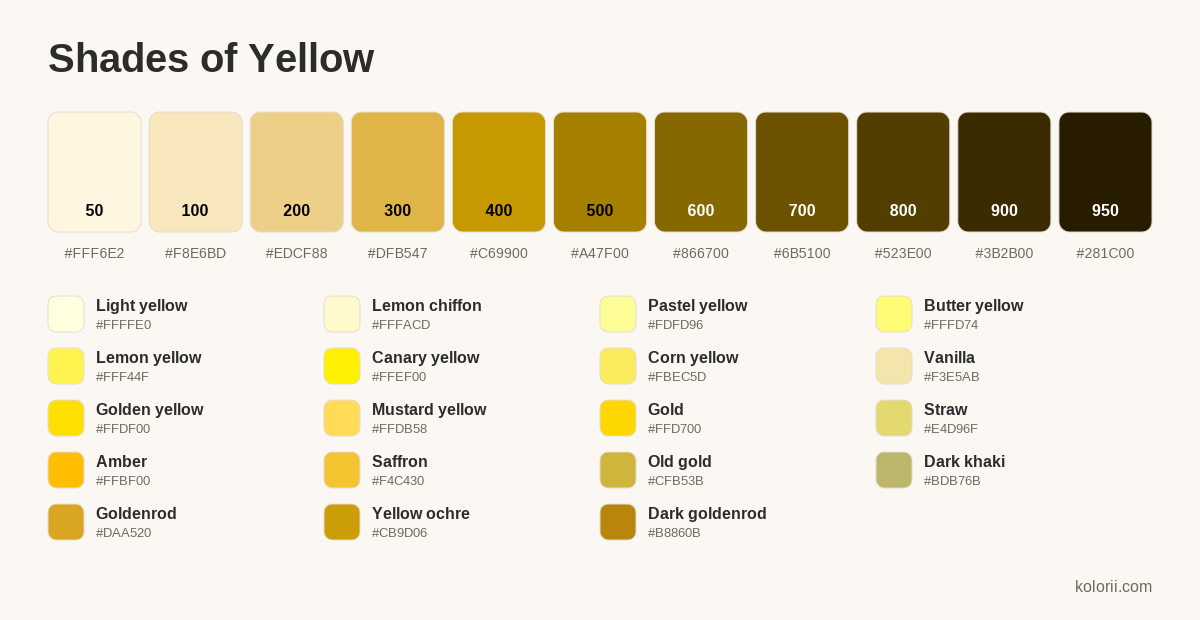
From almost-white light yellow to dark goldenrod, here are the different types of yellow, each with its name and code. Click a swatch to copy its HEX, RGB or CMYK code, or make your own shade of yellow with the sliders.
Yellow 500
Closest named shade: Dark goldenrod #B8860B
#A47F00 rgb(164, 127, 0) 0, 23, 100, 36 hsl(46, 100%, 32%) Make your own shade
Pale, soft yellows: vanilla, pastel yellow, butter yellow and straw.
Bright, true yellows: lemon, canary, corn, gold, mustard and saffron.
Deep yellows leaning toward ochre and golden brown: goldenrod, old gold, dark goldenrod.
Every shade of yellow on this page with its HEX, RGB and CMYK codes, copied in one click.
| Shade | HEX | RGB | CMYK | |
|---|---|---|---|---|
| Light yellow | #FFFFE0 | rgb(255, 255, 224) | 0, 0, 12, 0 | |
| Lemon chiffon | #FFFACD | rgb(255, 250, 205) | 0, 2, 20, 0 | |
| Pastel yellow | #FDFD96 | rgb(253, 253, 150) | 0, 0, 41, 1 | |
| Butter yellow | #FFFD74 | rgb(255, 253, 116) | 0, 1, 55, 0 | |
| Lemon yellow | #FFF44F | rgb(255, 244, 79) | 0, 4, 69, 0 | |
| Canary yellow | #FFEF00 | rgb(255, 239, 0) | 0, 6, 100, 0 | |
| Corn yellow | #FBEC5D | rgb(251, 236, 93) | 0, 6, 63, 2 | |
| Vanilla | #F3E5AB | rgb(243, 229, 171) | 0, 6, 30, 5 | |
| Golden yellow | #FFDF00 | rgb(255, 223, 0) | 0, 13, 100, 0 | |
| Mustard yellow | #FFDB58 | rgb(255, 219, 88) | 0, 14, 65, 0 | |
| Gold | #FFD700 | rgb(255, 215, 0) | 0, 16, 100, 0 | |
| Straw | #E4D96F | rgb(228, 217, 111) | 0, 5, 51, 11 | |
| Amber | #FFBF00 | rgb(255, 191, 0) | 0, 25, 100, 0 | |
| Saffron | #F4C430 | rgb(244, 196, 48) | 0, 20, 80, 4 | |
| Old gold | #CFB53B | rgb(207, 181, 59) | 0, 13, 71, 19 | |
| Dark khaki | #BDB76B | rgb(189, 183, 107) | 0, 3, 43, 26 | |
| Goldenrod | #DAA520 | rgb(218, 165, 32) | 0, 24, 85, 15 | |
| Yellow ochre | #CB9D06 | rgb(203, 157, 6) | 0, 23, 97, 20 | |
| Dark goldenrod | #B8860B | rgb(184, 134, 11) | 0, 27, 94, 28 |
In paint and in printing, yellow is a primary color: no mix of pigments makes it, so you start from a yellow tube or pencil. On a screen, though, red and green light add up to yellow. Every shade of yellow then starts from a basic yellow.
red light + green light
On a screen, red and green light add up to yellow. With paint, red and green make brown instead.
yellow + white
Add the yellow to the white: a pale yellow takes plenty of white and very little yellow.
yellow + a touch of orange
A touch of orange, or red, warms yellow up toward gold and amber.
yellow + a touch of brown
A touch of brown tones yellow down and gives it that warm, slightly muted look.
yellow + a touch of purple
To darken yellow, use a touch of purple, its opposite color, rather than black: black turns it greenish.
Depending on your supplies
With pencils, you don’t mix: you layer. Lay down the lightest shade in light strokes, then the darker one on top, without pressing. To lighten yellow, finish with a white pencil; to darken it, add a touch of grey or of its opposite color.
Water-based markers don’t blend well: pick the right shade straight away. With alcohol markers, go over a darker shade with a lighter one while it is still wet to soften the transition.
Mix on the palette, not on the paper. For a lighter shade, add water rather than white: the white of the paper does the lightening.
Acrylic or gouache: always add the dark color to the light one, a little at a time. Write down the amounts so you can find your shade again.
What happens when you mix yellow with other colors? Our color mixing guide answers with a 24-mix chart and a mixer that behaves like real paint.
Four palettes taken from the chart, ready for a coloring page or a design. Click a color to copy its code.
To choose the colors that go with yellow, our color wheel guide explains complementary colors and color harmonies, with an interactive color wheel that finds them for you.
A printable sheet to practice with: recreate each shade of yellow with colored pencils or paint, box by box.
One Letter page: the numbered chart with its codes, an empty row to recreate each shade, and a strip for your tests.
Three shades from the chart on a real drawing: the lightest in the center, the darkest at the edge.
Want to do it by hand? Pick a drawing to print or color online.
Endless: every mix makes a new shade. This page gathers the 19 best-known yellows with their names, and the chart gives 11 of them, from lightest to darkest.
Pure yellow is #FFFF00, or rgb(255, 255, 0). For a warmer yellow, use golden yellow (#FFDF00) or swatch 500 of the chart.
Add a touch of purple, its opposite color, or a little ochre. Black quickly turns yellow greenish.
Among the most used: mustard yellow, lemon yellow, pastel yellow and golden yellow.
Grey for a modern yellow, navy blue for contrast, off-white and sage green for a soft look.