
The printable sheet
One Letter page: the numbered chart with its codes, an empty row to recreate each shade, and a strip for your tests.
Free tool · color chart
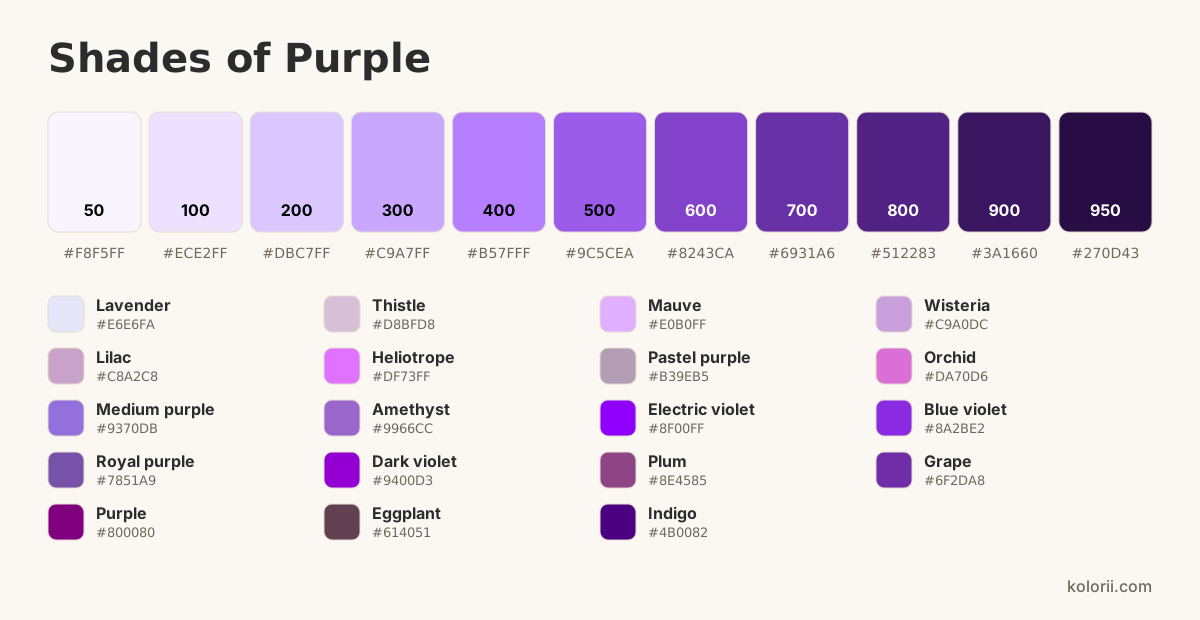
From almost-white lavender to deep indigo, here are the different types of purple, each with its name and code. Click a swatch to copy its HEX, RGB or CMYK code, or make your own shade of purple with the sliders.
Purple 500
Closest named shade: Medium purple #9370DB
#9C5CEA rgb(156, 92, 234) 33, 61, 0, 8 hsl(267, 77%, 64%) Make your own shade
Soft purples, from lavender to lilac and mauve: light and almost pastel.
Bolder purples, from pinkish orchid to blue violet and royal purple.
Deep purples: purple itself, plum, eggplant and indigo, close to midnight blue.
Every shade of purple on this page with its HEX, RGB and CMYK codes, copied in one click.
| Shade | HEX | RGB | CMYK | |
|---|---|---|---|---|
| Lavender | #E6E6FA | rgb(230, 230, 250) | 8, 8, 0, 2 | |
| Thistle | #D8BFD8 | rgb(216, 191, 216) | 0, 12, 0, 15 | |
| Mauve | #E0B0FF | rgb(224, 176, 255) | 12, 31, 0, 0 | |
| Wisteria | #C9A0DC | rgb(201, 160, 220) | 9, 27, 0, 14 | |
| Lilac | #C8A2C8 | rgb(200, 162, 200) | 0, 19, 0, 22 | |
| Heliotrope | #DF73FF | rgb(223, 115, 255) | 13, 55, 0, 0 | |
| Pastel purple | #B39EB5 | rgb(179, 158, 181) | 1, 13, 0, 29 | |
| Orchid | #DA70D6 | rgb(218, 112, 214) | 0, 49, 2, 15 | |
| Medium purple | #9370DB | rgb(147, 112, 219) | 33, 49, 0, 14 | |
| Amethyst | #9966CC | rgb(153, 102, 204) | 25, 50, 0, 20 | |
| Electric violet | #8F00FF | rgb(143, 0, 255) | 44, 100, 0, 0 | |
| Blue violet | #8A2BE2 | rgb(138, 43, 226) | 39, 81, 0, 11 | |
| Royal purple | #7851A9 | rgb(120, 81, 169) | 29, 52, 0, 34 | |
| Dark violet | #9400D3 | rgb(148, 0, 211) | 30, 100, 0, 17 | |
| Plum | #8E4585 | rgb(142, 69, 133) | 0, 51, 6, 44 | |
| Grape | #6F2DA8 | rgb(111, 45, 168) | 34, 73, 0, 34 | |
| Purple | #800080 | rgb(128, 0, 128) | 0, 100, 0, 50 | |
| Eggplant | #614051 | rgb(97, 64, 81) | 0, 34, 16, 62 | |
| Indigo | #4B0082 | rgb(75, 0, 130) | 42, 100, 0, 49 |
Red and blue make purple. The result depends on your paints: magenta and a cool blue give a vivid purple, while an orange-red gives a dull, brownish one. More blue cools it down, more red pushes it toward magenta.
red + blue
Equal parts red and blue. For a bright purple, use magenta and a cool blue: an orange-red makes a dull purple.
purple + plenty of white
A purple lightened with plenty of white. A touch of pink makes it softer.
purple + white + a touch of pink
Purple and white, warmed with a touch of pink: mauve sits between lilac and pink.
purple + a touch of brown
A touch of brown darkens and warms purple; black would make it greyer.
Depending on your supplies
With pencils, you don’t mix: you layer. Lay down the lightest shade in light strokes, then the darker one on top, without pressing. To lighten purple, finish with a white pencil; to darken it, add a touch of grey or of its opposite color.
Water-based markers don’t blend well: pick the right shade straight away. With alcohol markers, go over a darker shade with a lighter one while it is still wet to soften the transition.
Mix on the palette, not on the paper. For a lighter shade, add water rather than white: the white of the paper does the lightening.
Acrylic or gouache: always add the dark color to the light one, a little at a time. Write down the amounts so you can find your shade again.
What happens when you mix purple with other colors? Our color mixing guide answers with a 24-mix chart and a mixer that behaves like real paint.
Four palettes taken from the chart, ready for a coloring page or a design. Click a color to copy its code.
To choose the colors that go with purple, our color wheel guide explains complementary colors and color harmonies, with an interactive color wheel that finds them for you.
A printable sheet to practice with: recreate each shade of purple with colored pencils or paint, box by box.
One Letter page: the numbered chart with its codes, an empty row to recreate each shade, and a strip for your tests.
Three shades from the chart on a real drawing: the lightest in the center, the darkest at the edge.
Want to do it by hand? Pick a drawing to print or color online.
Endless: every mix makes a new shade. This page gathers the 19 best-known purples with their names, and the chart gives 11 of them, from lightest to darkest.
The standard web purple is #800080, or rgb(128, 0, 128). For a brighter purple, use amethyst (#9966CC) or swatch 500 of the chart.
Lavender (#E6E6FA) is an almost-white purple, lilac (#C8A2C8) a light, slightly greyed purple, and purple itself the strong color between red and blue.
Among named purples, indigo (#4B0082) and eggplant (#614051) are the darkest.
Gold for a rich purple, soft green for contrast, grey for a softer, understated look. Our purple gradients show ready-to-download examples.
